

How deep goes this horror idea hole?
Obsession and a horror idea nesting doll of conceptual continuum; New Logo Alert; Game show episodes being stockpiled for you as we speak:)

Happy Thursday! At the advent of some new subscribers to the newsletter over the past few weeks, today we embody Scribbled Loose at its essence.
On deck:
A cool tale of iterative ideation in horror themes vis a vis Obsession, The Simpsons and an old short story
Dope insights from The Creative Act on tuning in to the creative frequency
New logo… in case you haven’t noticed; PLUS Game Show updates
Spread the love! —
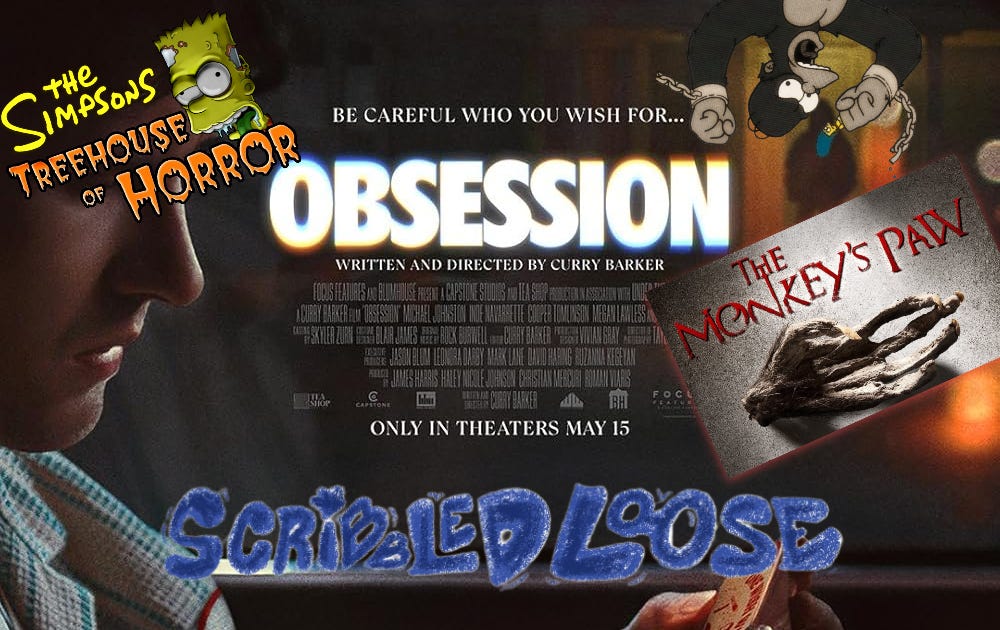
In Season 3, Episode 7 of the Simpson’s, “Treehouse of Horror II,” Lisa, Bart and Homer endure three distinct nightmares. Lisa’s, in particular, where Homer purchases a monkey paw that grants three disastrously claused wishes, happened to serve as the final inspirational punch to Curry Barker’s Obsession, a film on a tight track to break all the debut horror records in the book.
My Letterboxd Obsession Review
But before Barker employed its insights, ignited by the deeply human noumena of the “curse concept”, the Simpsons’ writers room had. The original source material? W.W. Jacobs’ short story, ‘The Monkey’s Paw’ which begins in a cozy cottage, where a comfortable family gets paid a visit by a sergeant who’s come to tell of his travels abroad. A trip where he acquired a Monkey Paw that supposedly grants three wishes to three separate men. The White family, quick to succumb to intrigue, call dibs and begin making their wishes. Their son is the first to fall, after a wish for £200 mutates into a £200 compensation on account of his brutal death at the workplace … the other two follow, with adequate and corollary disaster.
This nesting doll of intertextuality represents a particularly compelling concept coined by Rick Rubin I’ll refer to as “source sensitivity,” the practiced capacity to remain open to creative input from outside the self, cultivating open receptivity: like tuning a radio frequency, adjusting our minds to quietly listen to inspiration’s ‘whispers’”
“We are all antennae for creative thought. Some transmissions come on strong, others are more faint. If your antenna isn’t sensitively tuned, you’re likely to lose the data in the noise. Particularly since the signals coming through are often more subtle than the content we collect through sensory awareness.”
But my interest in this lovely creative aphorism is less about the principle of it and more about what it says about how meaning is made and transmitted throughout genre filmmaking. Today, that genre is horror.
W.W Jacob’s short story “The Monkey’s Paw” was published in 1902 and it has certainly made its rounds in the horror sphere (ie. it was Stephen King’s primary inspiration for Pet Sematary) Needless to say, as one of the most influential horror stories of all time, I can’t help but shove a magnifying glass up the arse of such legacy to discover, Why? How? and What sustains its enduringly iterable essence in terms of the meaning it carries to each film that inherits its thematic DNA?
Jacobs built his reputation on humor, and with a range showcased by his much darker tales, his career serves as a compelling illustration of the well-studied, psychologically-backed intersection between humor and horror. But his reputation was also built on his authenticity. A perhaps under sung ingredient to his special sauce, he was deeply shaped by the working-class realities of the maritime workers around him—that includes dockworkers, longshoremen, and bargees within London’s docklands. As a young chap growing up in the Wapping docks of Britain, he would regularly absorb the misadventures of the trade, most directly from his father who was a wharf manager. For this, his work maintained a refreshing fidelity to local cockney dialect and thus slotted into a comedic style that was more refined than caricature, but less high brow than upper-class literary satirists like Oscar Wilde or P.G. Wodehouse. Through a detached, third person perspective Jacob drew from an irony and suggestive restraint that allowed him to absorb (and editorialize) the many absurdities one might gather as a fly on the wall during a common maritime story, which likely included a colorful spectrum of petty rivalries and romantic entanglements.
These maritime anecdotes-turned-macabre preoccupations find themselves in “The Monkey’s Paw” where Jacobs juxtaposes the mundane and the monstrous. Where a family discovers the terrible price of their wishes. Whether the paw’s power springs from the psyche or the supernatural, the sheer ambiguity of its evil, and its implication of ‘random’ cruelty is uniquely unsettling. A narrative whose horror lies in the callous indifference of a curse you willingly invoke. A timeless paradigm of the psychological depths that elevate horror beyond mere shock. Every wish and ensuing curse becomes a mirror reflecting the dominant anxieties of an era. For Jacobs, economic insecurity, for Barker, romantic alienation, and for the Simpsons, a rare three-fold of celebrity culture, political idealism and Consumerism. The curse mechanism particularly makes way for a moral ambivalence that nurtures characters’ understandable desires for wishing whatever they do. It encourages an open-ended dread that spans the lengths of human selfishness and desire. The curse’s enduring power, in my assessment, comes from how the vehicle, perverse and pervasive in consequence, exposes the nasty below the mundane and exploits the unassuming to create a horror that’s deeply personal and ravenous for the human emotional voids.
If you’re reading this and you’ve been a subscriber for longer than a week, you might have noticed our new branding, a stunning novelty I owe to my friend Luke Gil, who’s also cheffing up on the episode layout for the game show!
We are absolutely hawking for submissions so share the link if you’re a friend or a foe or if you’ve got a movie take you’d love to get off your beautiful chest.