

...for the sake of image
What making political commentary TikToks taught me about my calling and public perception.

Every ship has its crew. A network of roles working to keep the vessel steady and on course.
There is a precise reason for each of these roles. Sure, there’s reasonable overlap. The captain was once a deckhand and they could likely perform any number of positions with the same level of adequacy. But what they’d lack is the designation of those positions, which comes with a special kind of ownership, one that compels you to understand the nuances and perform them with personalized intention.
On the brink of Biden’s drop from the presidential race last year, thus at a great height of media chaos and political confusion, I began putting my thoughts to paper (Substack essays online) and then to video, creating bite-sized TikToks that broke down headlines and disseminated truth amid the unrelenting waves of mis- and disinformation. As a film student in undergrad, the instinct to turn political commentary into visual form felt natural. Not to mention this pursuit happened to coincide with a heavy-handed push from my parents to attend law school—followed by my incongruous path to agreement, applications to countless law schools, and, eventually, the acceptance of my own direction: filmmaking and creative production.
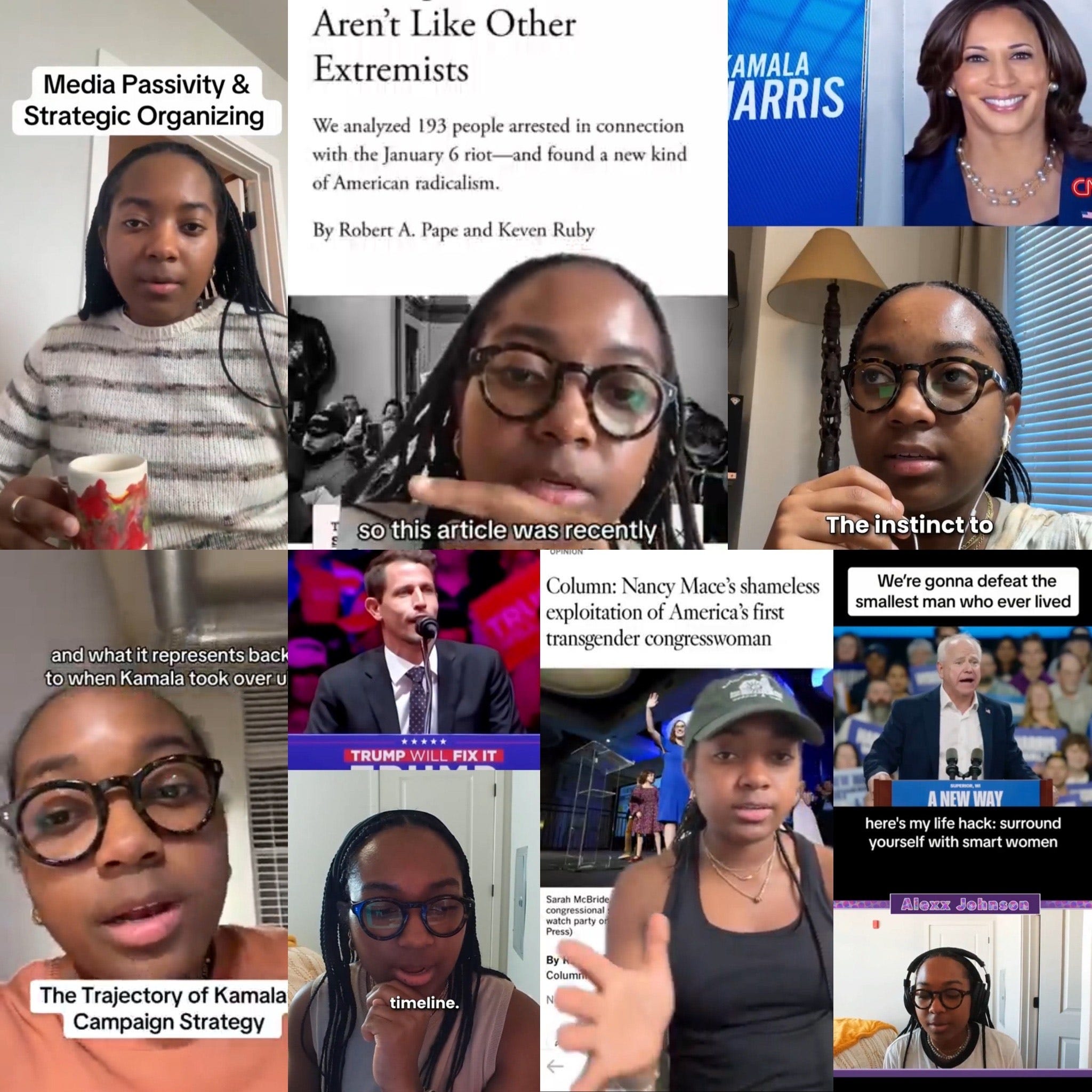
Having researched, scripted, and uploaded close to 50 videos during the Harris campaign, covering topics surrounding U.S. electoral politics, Palestinian liberation, media propaganda, and the material roots of authoritarianism, I came to the drawn-out conclusion that the role of "online political voice"—the type of leftist who thrives voicing radical critiques through a solo online persona—is best suited for those who find clarity and purpose in speaking directly to the lens and have the charisma and personal image required to sustain constant visibility.
While I value that clarity, and found great enthusiasm making and receiving engagement through distilling often complex topics into digestible narratives, I’ve always found my own public-facing insights sharpen best in dialogue with others (hence my ongoing outlet Going Far Show, where I engage in conversations that explore the topics I write about and obsess over with others). But writing remains and has proven itself to the most valuable outlet to me—the place where I process, refine, and challenge ideas most fully.
This process of realization and recognition of my own strengths and ambitions served as a much needed lesson that happened to apply to several areas of my life all at once.
In dating, I was sustaining a relationship I didn’t feel seen in and that was not serving me, largely for the sake of image. Professionally, I was entertaining a career path chosen by my parents (well-intentioned though they were) that I wasn’t called to—again, for the sake of image.
Image, and its pleasures, can distort our true identity just as much as it can fortify it. Knowing the extent of its insistent force, as both a weapon and a tool, should become our construction manual for building an image that serves our purpose, not overshadows it.