

Creepy Cars and Horror Films
White vans and the likes... Movies that went vroom vroom and shook the soul.

Welcome back to Scribbled Loose, a newsletter prodding the sites of meaning making within the creative process. Join a community of creative torchbearers and process curious infiltrators today!

I’m starting a movie examination series, NOT to be mistaken for movie reviews.
My opinion on the traditional movie review is pretty straight forward. I lay it bare here. I find them to be an incomprehensive form deployed for comprehensive conclusions on film, a confounding contradiction when the only conclusive thing about a movie is the moment it finishes playing, which coincides with the moment it leaves its lasting imprint on you. I think their outsized focus on evaluations of plot, cinematography, acting, direction broadly flatten the holistic, experientially inclined dialogue movies foment, painting them as something unidirectional, to be interpreted as worthy or not in review-classic terms. And perhaps the most major pity of all is the way they uplift a formulaic approach to filmmaking that falls at the feet of the same set of standards probably espoused by 3-5 of the most influential critics, all aged 45 and above.
NOT ROUND HERE PARTNER!
My favorite “reviews” are the ones that dive head first into what stuck. The ones that preserve the indelible two-way dialogue between audience and movie by discussing their most personal effects . I wanna hear someone talk about their unique cultural and thematic attachments to a film, narrowing in on the minute details they became obsessed with and the lived context that shaped that experience. That’s why Letterboxd is goated to me. Ratings are valued along the lines of individuality, not average. It’s the same difference that stands between flashy headlines and real journalism. I think these kinds of personal vignettes operate on a totally different scale than a movie review and aid in a deeper, more incisive absorption of movies as a whole. A true celebration of a film’s ability to morph what we think and how that dynamic plays out in reverse.
Today I’ll be carrying that torch forward with “Movie Meditations” here on SL.
Read a Movie Mediation I did on Panopticon here, a film by my undergraduate directing professor that has bestowed infinite wisdom upon me.
I’ll use them as an opportunity to ruminate on the granular elements of movies that really get me going.
Today, we’re talking cars and horror.
A late night drive I took the other day motivated this topic. I drove past a car pulled to the side of the road, probably innocuously checking for directions or finding the optimal playlist to blast on the rest of their drive. But those rationalizations made it no less creepy when I encountered it. It sparked an immediate memory of that white car at the beginning of Jordan Peele’s Get Out: malicious in intention but, at first, seemingly unimposing.
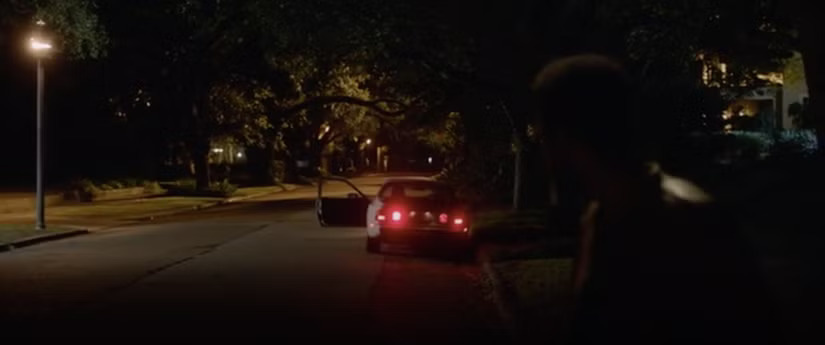
Countless movies prey upon the elusive spookiness of cars and the reasons they are spooky might seem obvious to you.
The almighty chasing power every vehicle contains.
The eyeball headlights resting right below the human eyeballs seating inside, definitely staring at you through that opaque windshield.
The general heinous heist-ly endeavors committed with cars, infamously white vans.
And you’d be right. All of those things contribute to our natural fear of still cars, especially at night. But a handful of movies have preyed on this fear, implanting images beyond what natural caution and experience can embody. I’d like to highlight a few that really did it for me. Not in the overt “car gets possessed and develops a jealous, murderous obsession with its owner kind of way.” – Christine (1983). But in the insidious, delicately fashioned kind of way.
<<SPOILER WARNING>>
Dead End (Fabrice Canepa, Jean-Baptiste Andrea, 2003) – There’s nothing quite like the suffocating elusivity of inviting a stranger into your car, no matter the circumstance. In Dead End, that feeling is compounded by the woman’s sheer strangeness: refusal to speak, dubious forehead scar and conspicuously swaddled baby in her grasp. The family rides down an inescapable road for the majority of the film and it becomes a kind of safeguard against the unpredictable elements of wandering women with bloody babies and violently cannibalistic make out sessions.
Funny Games (Michael Haneke, 1997) – When Susanne Lotha’s character Anna escapes the house of visceral horrors, she finds herself on a vacant road. When a car appears, making its way down and toward her bruised and battered body, she does what many could argue reasonable, flags it down for a ride as far away as she could get. The composition of the moment makes the detriment all the more inevitable, with the headlights lighting up the dark, long path toward her.
It Follows (David Robert Mitchell, 2014) – In one of my all time favorite horror films of all time, cars bear witness to a huge portion of the trauma but primarily as a getaway. Jay (Maika Monroe) is under constant threat of death by a villainous entity taking on various physical forms, but the entity travels by foot. Vehicles present an obvious life-extending opportunity for safety but also, by nature, only offering a temporary shield to capture.
Hereditary (Ari Aster, 2018) – This occurrence happens inside the car and it’s Hereditary’s major bone shilling shift. Cars can be modes of escape and rescue, Peter certainly thought so as he raced to a hospital with his sister enduring anaphylactic shock in the back seat. But in typical horror fashion, the most horrendous thing that nobody thought could result from a blindsiding deer in the road, did. His sister Charlie’s decapitation was a single shot blow from a telephone pole and in one of the most visceral uses of POV, the camera takes on Peter’s perspective as he wills himself to look at the fallout through the rearview mirror, then jerks his gaze away.
All the Beauty and the Bloodshed (Laura Poitras, 2022) – This a provocative, energizing documentary traversing the works and experiences of Nan Goldin. Nan was frequently subjected to threats and violence throughout her career, specifically during the peaks of her activist efforts. There’s a moment in particular where Nan’s friend Meg details a menacing stalker, car-perched and lurking outside her home. He began taking pictures of her from inside the vehicle, every night when she arrived home. The same little punk was found creeping outside of Nan’s home shortly after.
I like narrowing in on symbols like this not just for symbolic purposes but for utility. For the filmmakers in the room, you know these particulars are the apparatus from which we pull from to land a message in a way that’s grippingly tactile. For the enthusiasts, they help us to lock in and build stronger connections with what’s on screen.
These meditations will come in different forms. Sometimes I’ll lasso a handful of films to call out a shared motif or memorable quality, and other times I’ll explore a topic through the lens of a single film. I like to follow the whims of my inquiries and scratch till the itch goes away. You can certainly count on all of them functioning as a watchlist, if you gleefully come across any movies you haven’t seen.
I’ll see you in the next one (newsletter’s dropping twice a week)! - ASJ